Introduction
Artificial intelligence is now part of how many students, writers, and professionals create. From drafting essays to designing artwork, AI tools provide suggestions and speed up workflows. Yet the question remains: Does using AI limit you as a creative person? This discussion, often called the AI creativity limit, explores how technology influences originality, imagination, and human expression.
With tools like Kreativespace Paraphraser and Kreativespace Summarize, students already rely on AI for academic and creative tasks. But does this reliance hinder or enhance creativity?
What Is the AI Creativity Limit?
The AI creativity limit refers to the concern that depending too much on AI could restrict originality. Creativity involves connecting ideas, solving problems, and expressing unique perspectives. AI, by contrast, generates output based on existing patterns in data.
Some argue this makes AI inherently limited, since it cannot “think” like humans. Others believe AI frees people to focus on higher-level ideas by automating repetitive work.
Inline image alt text: Digital illustration showing human and AI working together on creative tasks.
AI and Creativity: A Balanced View
Understanding AI and creativity means recognizing both strengths and weaknesses.
Strengths
- Idea generation – AI offers starting points when inspiration is lacking.
- Efficiency – saves time on research and first drafts.
- Skill support – helps non-experts polish grammar, structure, or translation.
- Collaboration – acts like a brainstorming partner.
Weaknesses
- Overreliance – may reduce deep thinking if used passively.
- Repetition – AI output may feel generic.
- Context gaps – lacks emotional depth or cultural nuance.
For balance, creators can use AI to draft, but refine with personal judgment and imagination. According to MIT Technology Review, AI is best seen as a co-creator rather than a replacement.
Does AI Limit Creativity in Students?
In education, the concern about does AI limit creativity is significant. Students might lean on tools to finish essays or generate ideas quickly. Yet, when guided properly, AI can enhance rather than limit:
- Brainstorming essays – AI offers outlines, while students shape arguments.
- Summarizing sources – AI helps filter content, but critical analysis is still human-driven.
- Creative writing – AI provides prompts, but originality comes from the student’s unique perspective.
Using the Kreativespace Grammar Checker ensures final drafts remain polished and student-driven.
Human Creativity vs AI
Comparing human creativity vs AI highlights key differences:
- Humans draw from lived experiences, emotions, and imagination.
- AI draws from data, patterns, and algorithms.
While AI lacks consciousness, it can still produce fresh combinations of ideas. Students benefit when they use AI as a tool rather than as a replacement for their own creativity.
The Kreativespace AI Humanizer is one example of how students can make AI output more natural, ensuring their voice remains central.
Creativity with AI Tools
The reality is that creativity with AI tools often looks like collaboration. For example:
- A design student uses AI to generate concept sketches, then adds unique touches.
- A literature student uses an AI summary to understand texts, then builds original interpretations.
- A language learner uses the Kreativespace Translator to access global resources, then writes essays with their own perspective.
This synergy demonstrates that the AI creativity limit is not about whether AI restricts ideas, but about how humans use the technology.
Where AI Excels and Where It Doesn’t
AI excels at:
- Drafting quickly
- Processing large amounts of data
- Offering structured outputs
AI struggles with:
- Deep originality
- Emotional resonance
- Ethical judgment
According to Harvard Business Review, the most innovative outcomes happen when AI and humans combine strengths.
KreativeSpace as a Creative Partner
KreativeSpace provides a toolkit that shows how AI supports creativity:
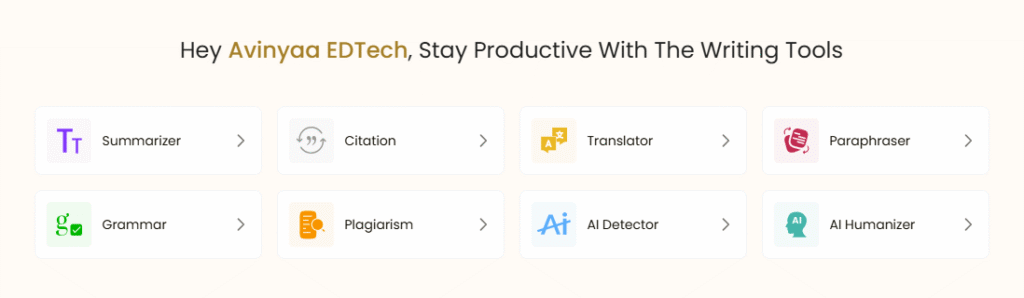
- Summarize – condenses research for idea building.
- Paraphraser – rephrases ideas for new perspectives.
- AI Detector – checks originality.
- Plagiarism Checker – ensures unique work.
- Citation Generator – formats references quickly.
Together, these tools reduce repetitive tasks so students can focus on creativity.
How to Avoid the AI Creativity Limit
Students and professionals can prevent AI from limiting their creativity by following best practices:
- Use AI for support, not replacement – let AI draft or summarize, then refine personally.
- Blend ideas – merge AI suggestions with your own insights.
- Check originality – always verify content with plagiarism and AI detectors.
- Add personal context – weave in experiences, opinions, and emotions.
- Learn continuously – treat AI as an assistant, not an authority.
The Kreativespace AI Humanizer ensures AI-assisted writing remains authentic and student-focused.
The Decider
So, does using AI limit you as a creative person? The answer depends on how it is used. The AI creativity limit is not a fixed barrier but a reminder that creativity requires human imagination.
When paired with the right tools, AI supports originality, efficiency, and confidence. Kreativespace offers summarizers, paraphrasers, grammar checkers, and plagiarism detectors that free students from repetitive tasks while keeping them in control of creative direction. Outbound insights from MIT Technology Review and Harvard Business Review confirm that AI works best as a partner, not a replacement.
The decider is clear: AI only limits creativity when misused. Used wisely, it expands opportunities, enhances learning, and helps students bring their most original ideas to life.